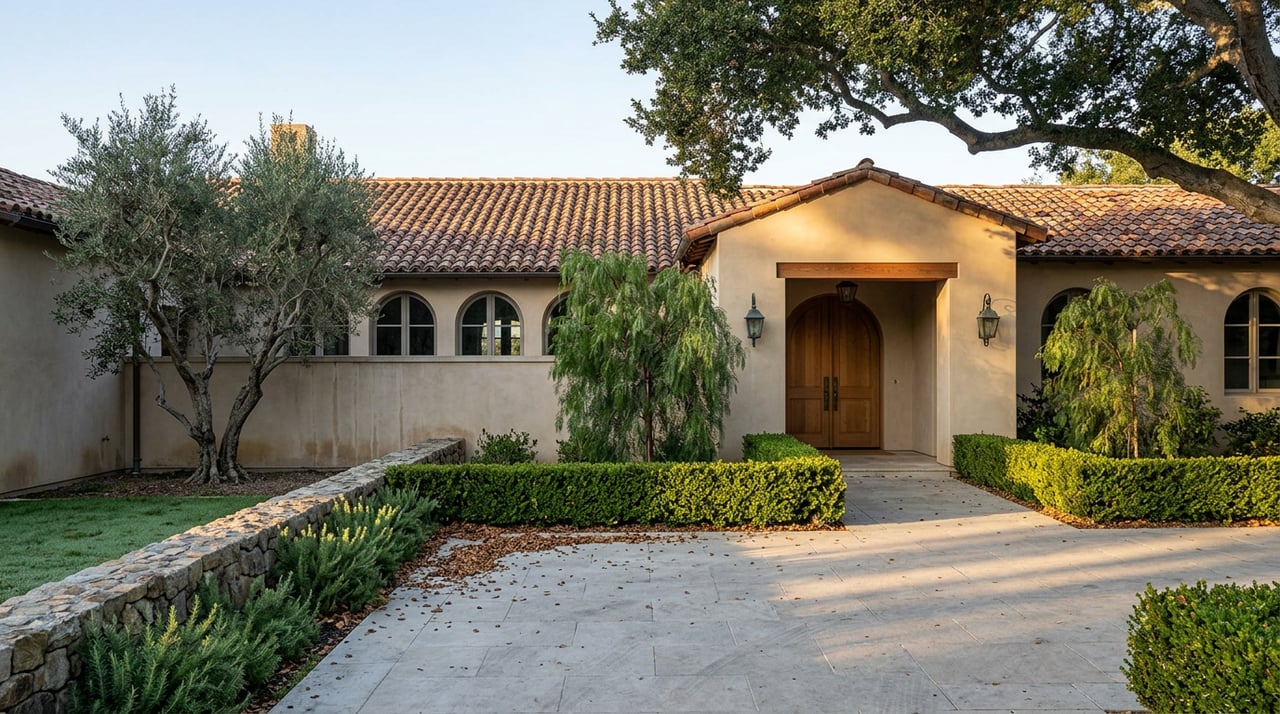
Picture two houses on the same street in the Covenant. Same lot size, same architect, same six thousand square feet of Spanish Colonial roofline. One owner bought in the early 2000s and has lived there ever since. The other closed within the past year. Both belong to the same association, ride the same trails, and have access to the same golf course. Their monthly association bill is not the same number. It is not close.
That gap is not a billing error. It is how the Rancho Santa Fe Association is built, and it is the first thing a buyer comparing Rancho Santa Fe to Del Mar or La Jolla needs to understand before running the math on what ownership here actually costs.
The Formula Behind the Bill
Most homeowners associations charge a flat rate. Every unit in a condo building pays the same monthly fee, or every lot in a subdivision pays the same annual assessment, regardless of what any individual owner paid for their place. The Rancho Santa Fe Association does something different. For fiscal year 2026, MyRSF.net reports that the Rancho Santa Fe Association assessed every member property fifteen cents per hundred dollars of county-assessed value. Compare that to the roughly one percent rate that applies to property taxes themselves, and the mechanism becomes clear: your association dues are a small slice of the same number the county uses to tax you, not a fixed line item set by square footage or lot size.
Run that formula on two properties and the spread shows up immediately. A home with a two million dollar assessed value pays about three thousand dollars a year in dues under that rate, or roughly two hundred fifty dollars a month. A home assessed at six million dollars, using the same formula, pays about nine thousand dollars a year, or seven hundred fifty dollars a month. Same association. Same amenities. Triple the bill.
Why This Is Personal, Not Just Procedural
Here is where California property law makes the story sharper. The California State Board of Equalization explains that under Proposition 13, a property's assessed value is largely frozen at its purchase price and rises slowly while the same owner holds it, then resets to market value the moment it sells. A longtime Covenant owner is often paying dues against an assessed value that reflects what the house was worth decades ago. A buyer closing today pays dues against what the house is worth now.
The practical result, according to the independent resident site MyRSF.net, is that members who have recently purchased in Rancho typically pay far more in association dues than members who have owned their homes for years, purely as a byproduct of how property taxes are calculated under Prop 13. Two owners with the same house, the same trail access, and the same golf privileges are contributing very different amounts to the same association budget, and the difference has nothing to do with how either of them uses the community.
For a buyer, that means the dues figure you get quoted during escrow is not a stable number you can extrapolate from your neighbor's experience. It is tied to your purchase price, not theirs, and it will likely be the highest dues anyone on that street has paid, at least until the next sale resets someone else's basis too.
What Roughly Four Hundred a Month Buys
The association's FY2026 budget runs about thirty three million dollars, with roughly ten million of that coming from member dues and the remaining twenty three million from club memberships and user fees. Spread across the association's approximately two thousand forty four member properties, that dues pool works out to an average of around four hundred eight dollars a month per household, though as the math above shows, individual bills vary widely around that average depending on assessed value.
That budget funds something closer to a small municipal operation than a typical HOA. The association employs around one hundred seventy nine people across golf course maintenance, the restaurant, parks and recreation, a private security patrol, and a building department that reviews architectural applications. It maintains close to sixty five miles of horse trails, runs Osuna Ranch as a working boarding and training facility, and covers costs for the Tennis Club and the golf club's clubhouse operations, both of which are largely self funded through member and user fees rather than the core dues assessment. For a buyer comparing the sticker price of Covenant dues to a flat HOA fee in a gated community elsewhere, the fair comparison is not just the number but what that number is standing up: an association that functions, in the words of its own materials, much like a small city.
Not Every Rancho Santa Fe Address Plays by This Rule
The formula above applies inside the historic Covenant, the roughly ten square mile, sixty seven hundred acre core that most buyers mean when they say they want to live in Rancho Santa Fe. It covers close to nineteen hundred detached homes and around forty three hundred residents, governed by the Rancho Santa Fe Association and its Art Jury design review board.
Step outside that boundary and the rules change entirely. Communities like Fairbanks Ranch, The Bridges, and Cielo sit near Rancho Santa Fe but operate under their own separate homeowners associations, with their own architectural committees and their own club membership terms. Lot sizes in these communities often run smaller than Covenant estates. A buyer touring both in the same afternoon needs to ask which governing document applies to the specific address, not assume that "Rancho Santa Fe" means one uniform cost structure across the area.
The Other Signatures You Will Need
Dues are one layer of friction. They are not the only one. Water service across much of Rancho Santa Fe comes through the Santa Fe Irrigation District rather than a standard municipal utility, and wastewater handling varies parcel by parcel. Many Covenant estates run on septic systems rather than public sewer, which matters directly if you are planning to add a guest house, an accessory dwelling unit, or additional bedrooms.
Speaking of the Art Jury, any exterior project of consequence in the Covenant, from a major remodel to a new barn to a pool addition, moves through three separate layers of review rather than one. The association's Art Jury evaluates design and site fit. San Diego County, since Rancho Santa Fe is unincorporated, still requires its own building and grading permits regardless of what the association approves. And the Rancho Santa Fe Fire Protection District requires automatic sprinkler systems in residential structures along with landscape and fuel modification plans, a layer of review that carries real weight given the area's wildland-urban interface exposure. None of these three bodies substitutes for the other two. A renovation timeline that assumes association approval is the finish line is usually wrong.
What This Means Against the Rest of the Coast
As of February 2026, Redfin data put the Rancho Santa Fe median sale price at roughly $3.995 million, with an average price per square foot near $1,360. Single-family sales commonly land between three million and ten million dollars, with large custom estates on prime acreage reaching well beyond that. Those numbers tell you what the house costs at closing. They do not tell you what it costs to hold.
The real comparison a buyer needs, whether they are cross-shopping Rancho Santa Fe against a comparable estate in Del Mar or a view property in La Jolla, is total carrying cost: property tax, association dues calculated against your specific purchase price rather than a flat rate, septic or water district considerations that affect future building plans, and a permitting sequence that can run through three separate reviewing bodies before a shovel goes in the ground. The list price is the easy number to find. The dues formula, the utility setup, and the approval stack are the numbers that determine whether the house fits your plans and your budget five years in.
A Few Questions Worth Asking Before You Tour
Does every Rancho Santa Fe property pay association dues under this formula? No. The formula applies to properties inside the historic Covenant, governed by the Rancho Santa Fe Association. Nearby communities like Fairbanks Ranch, The Bridges, and Cielo run their own separate associations with different dues structures entirely.
Can my dues change significantly after I close? Your dues are tied to your assessed value, which is generally set near your purchase price under California property tax law and adjusts modestly each year after that while you own the home. A future owner who buys after you, at a different price, will be assessed differently, not you retroactively.
Does buying an older, previously-owned home mean permanently lower dues? No. What matters is your own purchase price and resulting assessed value, not the home's age or its prior sale history. A newly built home and a decades-old estate assessed at the same value would generally carry comparable dues under the same formula.
Rancho Santa Fe rewards buyers who ask about the mechanism behind the number, not just the number itself. If you are weighing a Covenant estate against options in Del Mar, La Jolla, or elsewhere along the coast, Maxine & Marti Gellens can walk you through what a specific property's assessed value, utility setup, and approval history actually mean for your budget and your renovation plans, before you are deep enough into escrow for any of it to be a surprise.
This article is general information, not legal, tax or financial advice. Consult a qualified professional about your situation.