A house on Camino de la Costa and a house on Calumet Avenue can sit less than two miles apart, carry similar ocean frontage, and face the same Pacific swell. Only one of them may have a presumptive right to build a wall against it. The difference has nothing to do with price, square footage, or how recently the kitchen was redone. It comes down to a single date stamped into California coastal law: January 1, 1977.
That date, and what it does to a home's shoreline rights, is an important part of due diligence on La Jolla oceanfront and bluff-top deals, and can affect what a buyer is actually purchasing.
What's Happening Right Now on Calumet Avenue
In Bird Rock, a stretch of bluff along Calumet Avenue has been crumbling in view of the public since early 2026. Crews tore out sections of a back patio in April after erosion undercut the ground beneath it, and neighbors along the block have been watching the same slope move for longer than that. Warning signs reading "Unstable Cliff, Stay Back" line the edge.
According to Hoodline, this past August, a San Diego hearing officer approved a 70-foot seawall for a home at 5360 Calumet Avenue after the bluff's safety rating dropped to 1.16, a factor of safety that leaves little room before instability becomes structural risk. The approved design will be shotcrete, sprayed concrete two feet thick, reinforced with 21 tieback anchors drilled into the bluff and hand-carved to match the surrounding rock. Two other emergency repair permits went through on the same block in 2025, at 5322 and 5316 Calumet, both processed faster because they were filed as emergencies rather than standard applications.
The 5360 Calumet project took the slower path in part because of when the house was built. It went up in 1985, eight years after the Coastal Act's cutoff for what counts as an "existing structure" entitled to armoring under Section 30235 of the Act. Homes built after that date, or substantially remodeled since, don't get the same presumption of protection. They have to demonstrate imminent danger and prove no other option exists, which is a higher bar and a longer process than the one available to older homes.
How the Date Shapes Shoreline Rights
The rule itself is straightforward. California's Coastal Act requires that seawalls and similar shoreline armoring be permitted when needed to protect existing structures from erosion. The Coastal Commission interprets "existing" as built before January 1, 1977, when the Act took effect. A home that predates that line may qualify for a presumption in favor of armoring if the ocean threatens it, depending on the property and its permit history. A home built after does not automatically get the same right. It can apply, but the standard is stricter, and outcomes vary by site.
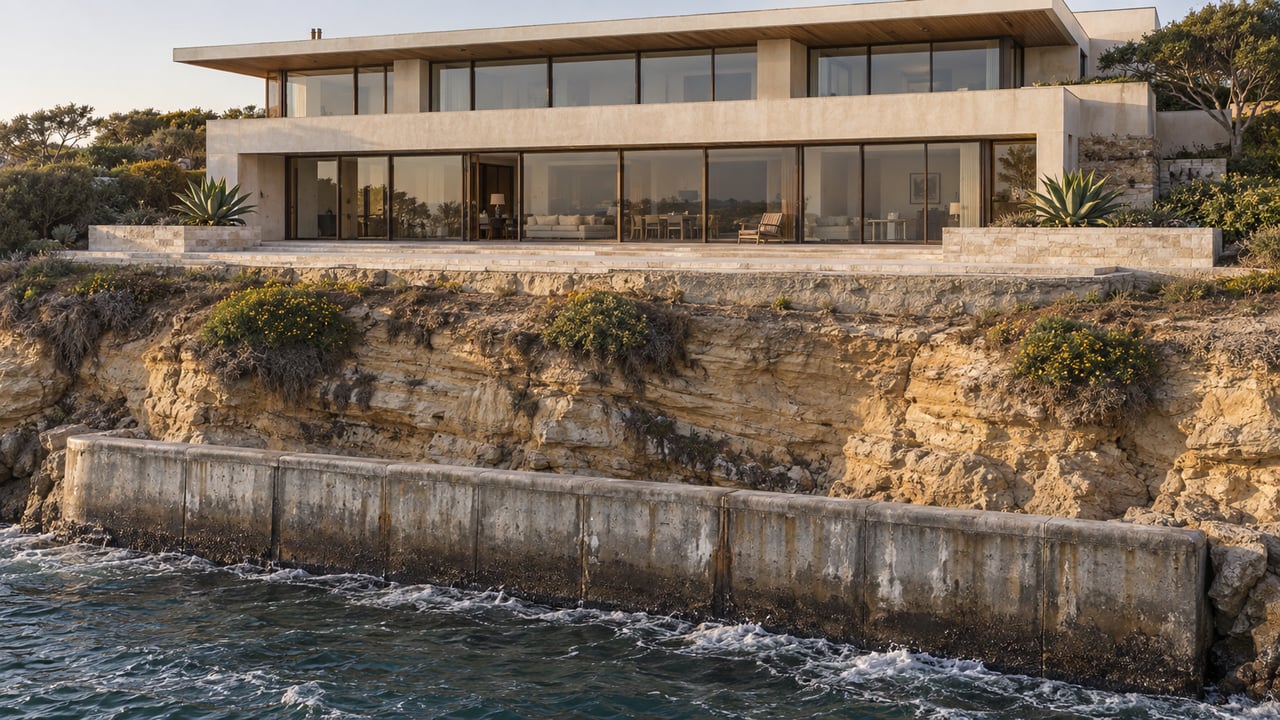
Nowhere is that contrast sharper than at a listing known locally as the Sandcastle, an oceanfront property at 1900 Spindrift Drive that came to market in 2025 for $108 million. Its seawall was built in the 1950s, decades before the Coastal Act, which may give the structure it protects a presumptive basis for continued armoring, depending on the property and its permit history. That single fact, more than the square footage or the shoreline frontage, is part of what the asking price is pricing in.
Compare that to a home built in the 1980s on a bluff two streets away in Bird Rock, which needs a hearing, a geotechnical report, and months of review to get permission for the same kind of protection, with no guarantee the Commission or the city will approve it on the first try.
How a Renovation Can Undo Decades of Protection
The 1977 line isn't only a problem for newer construction. It can catch owners of older, protected homes too, through a mechanism most buyers never think to ask about: the substantial remodel threshold.
In San Diego's coastal zone, altering more than half of a home's major structural components, meaning the foundation, roof, or exterior walls, typically triggers a full Coastal Development Permit review. That review often comes with a condition called a Waiver of Future Shoreline Protection, a deed restriction recorded against the property title. By accepting it, an owner gives up the right to build or maintain armoring in the future, and that waiver runs with the land. It binds every owner after them, not just the one who signed it.
A buyer who purchases a pre-1977 La Jolla oceanfront home with an existing, permitted seawall and then undertakes a significant renovation could unknowingly cross that threshold and lose the seawall rights that came with the house. The threshold itself isn't uniform. Some local coastal programs measure it by structural component, others by construction valuation, and the specifics matter enough that a written opinion from a coastal land-use attorney before writing an offer, not after closing, is the only way to know where a specific project lands.
| Pre-1977, unaltered | Post-1977 or substantially remodeled | |
|---|---|---|
| Baseline armoring right | Presumed under Coastal Act Section 30235 | Must prove imminent danger, no alternative |
| Typical review path | Existing permit maintained | Full Coastal Development Permit, hearing |
| Waiver of Future Protection risk | Low, unless remodeled | Common condition of approval |
| Review timeline | Maintenance and repair, weeks to months | Months to over a year, longer if appealed |
What Changes on July 1
Even for homes with clear armoring rights, the ground under them is being redefined. According to the Pacific Beach Builder's Guide, new coastal bluff setback guidance took effect in San Diego on July 1, 2026, building on the Coastal Resilience Master Plan the City Council adopted unanimously on September 9, 2025. The baseline setback in the municipal code has long been 40 feet from the bluff edge under Section 143.0143(f), with erosion and safety-factor additions typically bringing the real number to 53 to 55 feet. The July update, which folds in updated sea level rise projections and site-specific erosion rates rather than one regional average, is expected to push that total to roughly 63 to 64 feet.
Nine or ten additional feet sounds small until it's translated into buildable area on a constrained lot. In Pacific Beach and La Jolla, where property values run $2,000 to $3,000 per square foot, losing 200 to 300 square feet of buildable space represents somewhere between $400,000 and $900,000 in unrealized value on a given parcel. That's before accounting for the cost of the geotechnical analysis itself, which for a standard coastal bluff lot in this area runs $8,000 to $15,000 and takes four to eight weeks to complete.
A California Supreme Court ruling in April added a layer of nuance without changing the underlying math. On April 23, 2026, the court unanimously held that the Coastal Commission cannot arbitrarily override a city-approved coastal permit, a decision that reduces one kind of regulatory uncertainty for projects that clear local review. It does nothing to the bluff itself. Setback distances, erosion rates, and the 1977 cutoff are unaffected by who has final say over an approval.
What This Looked Like in Del Mar
The same regulatory environment shapes builds up and down this stretch of coast, not just in La Jolla. A $50 million sale in Del Mar at 2920 Camino Del Mar, which took the county's price record from La Jolla's previous $47 million sale at 6026 Camino De La Costa, included a protective seawall that took twelve years to permit from conception to completion. The builder involved described the regulatory changes since as having made the project impossible to duplicate today. That's the same friction La Jolla oceanfront owners are navigating, just measured in years rather than months.
Before You Write or Accept an Offer
These details are part of due diligence: they can be reviewed in a title report and permit file and discussed with the seller before the purchase agreement.
- Pull the preliminary title report and look specifically for an existing Waiver of Future Shoreline Protection recorded against the parcel.
- Request the full coastal development permit history from San Diego Development Services, including any prior remodels and whether they were flagged as substantial.
- Ask the seller directly whether an existing seawall was built under a permanent Coastal Development Permit or an emergency permit that was never converted, since the latter can be an unresolved liability the Commission can require removed.
- Budget for a site-specific geotechnical report before finalizing renovation plans, not after, especially on any lot near a bluff edge.
- Confirm whether the parcel sits in an appealable area, where a city approval can still be challenged directly to the Coastal Commission.
What Buyers Ask Before They Write an Offer
If I'm not planning to remodel, does any of this matter to me? It still matters for value and insurability. A home with clear, permanent seawall rights carries a different long-term position than one without, even if no work is planned this year or the next.
Can a home built after 1977 ever get shoreline armoring approved? Yes, but the standard is higher. The owner has to show the structure is in imminent danger and that no other option exists, and even then approval often comes with conditions that limit or waive future protection rights.
If you're evaluating an oceanfront or bluff-top property in La Jolla, whether you're buying, selling, or sorting through a family estate, the seawall question deserves the same early attention as price and location. Maxine & Marti Gellens can help you get the title report, permit history, and the right introductions in place before you're standing at the negotiating table.
This article is general information, not legal, tax or financial advice. Consult a qualified professional about your situation.